
Why Stable Voltage Is Important for Home Appliances
Voltage fluctuations damage appliances, increase repair costs, and shorten product life. Stable-voltage protection prevents these losses by disconnecting unsafe power or regulating output.
Stable voltage keeps appliances within their designed operating range. High voltage overheats components, low voltage strains motors and compressors, and repeated fluctuations shorten service life. Voltage protectors disconnect unsafe power, while automatic voltage regulators stabilize output, helping refrigerators, air conditioners, televisions, washing machines, and computers operate more safely and reliably.
The following sections explain the risks, solutions, and selection points buyers should understand before choosing protection products.
What Is Stable Voltage?
Stable voltage means that the electricity supplied to an appliance remains within its recommended operating range.
Most household appliances are designed for a specific rated voltage, such as:
-
110V
-
120V
-
220V
-
230V
-
240V
However, the actual voltage supplied by a local power grid may rise, fall, or fluctuate repeatedly.
This problem is common in areas with:
-
Overloaded electrical grids
-
Frequent power outages
-
Weak power distribution systems
-
Sudden changes in electricity demand
-
Unstable generators or transformers
When voltage remains stable, motors can start correctly, compressors can operate normally, and electronic control boards can process signals reliably.
How Unstable Voltage Damages Appliances
Unstable voltage usually appears in three main forms: high voltage, low voltage, and sudden power surges.
High Voltage
High voltage occurs when the incoming supply exceeds the appliance’s safe operating range.
Excessive voltage may:
-
Overheat internal components
-
Damage capacitors and transformers
-
Burn electronic control boards
-
Weaken wire insulation
-
Shorten appliance service life
-
Cause immediate equipment failure
Modern appliances are especially sensitive because they often contain microprocessors, digital displays, sensors, and electronic control systems.
A damaged control board may be expensive to replace, particularly in markets where original spare parts are difficult to obtain.
Low Voltage
Low voltage is also dangerous, especially for appliances containing motors or compressors.
When the voltage is too low, an appliance may draw more current to perform the same work. This creates additional heat and pressure inside the electrical system.
Low voltage can cause:
-
Difficult motor starting
-
Compressor overheating
-
Repeated restart attempts
-
Relay and capacitor damage
-
Reduced cooling performance
-
Premature appliance failure
Refrigerators, freezers, water pumps, washing machines, and air conditioners are particularly vulnerable to prolonged low-voltage conditions.
Voltage Spikes and Surges
A voltage spike is a sudden increase in electrical voltage.
It may occur after:
-
Power restoration
-
Lightning activity
-
Switching of heavy electrical loads
-
Generator connection
-
Grid faults
Although a spike may last only a short time, it can damage sensitive electronic components immediately.
Which Appliances Need Stable Voltage?
Almost every electrical appliance benefits from stable voltage, but some products require stronger protection.
| Appliance | Main Electrical Risk | Recommended Protection |
|---|---|---|
| Refrigerator | Compressor damage and rapid restarting | Voltage protector with delay |
| Air conditioner | High current and compressor overload | Heavy-duty AC protector |
| Television | Control board and power supply damage | Voltage and surge protector |
| Washing machine | Motor and electronic board failure | Voltage protector |
| Computer | Data loss and power supply damage | Surge protector or AVR |
| Freezer | Compressor overheating | Delay voltage protector |
| Water pump | Motor burnout under low voltage | Voltage protector |
| Router and decoder | Sensitive circuit damage | Multi-outlet protector |
The correct protection device should match the appliance’s voltage, current, and power requirements.
Voltage Protector or Automatic Voltage Regulator?
Voltage protectors and automatic voltage regulators provide different types of protection.
Voltage Protector
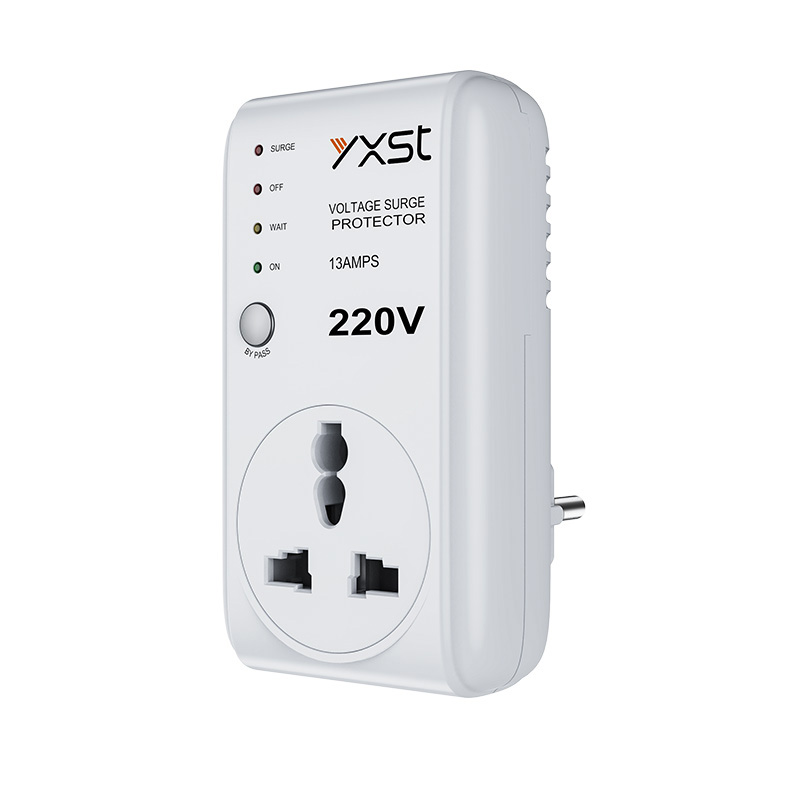
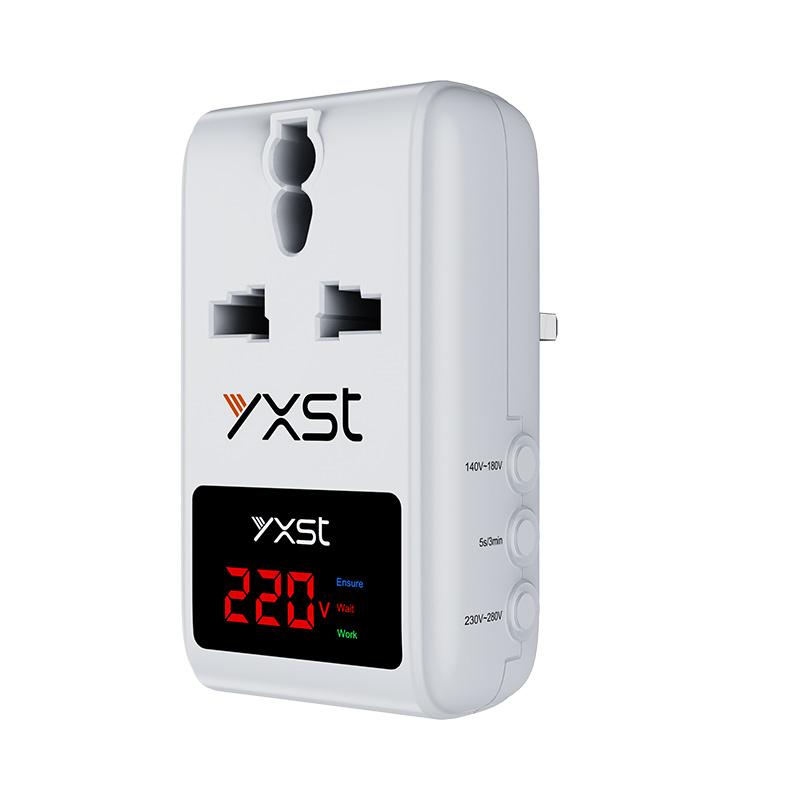
A voltage protector continuously monitors incoming electricity.
When voltage becomes too high or too low, the protector automatically disconnects the appliance. Once the voltage returns to a safe range, it reconnects the power.
Common features include:
-
High-voltage cutoff
-
Low-voltage cutoff
-
Automatic reconnection
-
Delay restart protection
-
LED status indicators
-
Real-time voltage display
Delay protection is especially important for refrigerators, freezers, and air conditioners. It prevents the compressor from restarting immediately after a power interruption.
Automatic Voltage Regulator
An automatic voltage regulator, also known as an AVR or voltage stabilizer, adjusts unstable input voltage and supplies a more stable output.
An AVR is suitable when voltage changes frequently but remains within the regulator’s supported input range.
Typical applications include:
-
Individual household appliances
-
Multiple electronic devices
-
Small offices
-
Retail shops
-
Home entertainment systems
-
Areas with continuously unstable electricity
Voltage protectors disconnect unsafe power, while AVRs actively regulate voltage. The correct choice depends on the local power conditions and the connected equipment.
How to Select the Right Protection Product
Importers, distributors, wholesalers, and retail buyers should evaluate several factors before purchasing voltage protection products.
1. Rated Voltage
The protector must match the local electrical system, such as 110V, 120V, 220V, or 240V.
2. Maximum Current and Power
High-power appliances require products with suitable current and wattage ratings. Air conditioner protectors, for example, may require heavy-duty relays and ratings such as 30A or 3600W.
3. Protection Range
The device should provide reliable high-voltage and low-voltage cutoff settings.
4. Delay Time
Compressors need sufficient restart delay after a power interruption. Adjustable or preset delay functions help reduce mechanical and electrical stress.
5. Plug Standard
Different markets require different plug types, including:
-
UK plug
-
EU plug
-
US plug
-
AR plug
6. Product Testing and Certification
Buyers should verify quality-control procedures, test reports, certifications, and supplier production capabilities.
Why Work With an Experienced Manufacturer?
Wenzhou Yixing Electronic Technology Co., Ltd. manufactures voltage protectors, surge protectors, air conditioner protectors, and automatic voltage regulators for international markets.
The company supports:
-
OEM and ODM customization
-
Multiple voltage settings
-
UK, EU, US, and AR plug standards
-
Customized housing and packaging
-
SMT mounting
-
Reflow and wave soldering
-
Injection molding
-
Assembly and quality control
-
CE-supported products
-
ISO9001 quality management
Complete in-house production helps improve product consistency, delivery stability, and customization efficiency for global importers and distributors.
Stable voltage protection extends appliance life, reduces failures, and delivers safer, more reliable power for homes and businesses.


 English
  Español
  Deutsch
  Français
  Italiano
  Português