
[Sharing] UPS(Uninterruptible Power Supply) knowledge
What is UPS?
UPS, the full name is Uninterruptible Power Supply, and the Chinese name is Uninterruptible Power Supply. It uses battery chemical energy as backup energy to continuously provide (AC) power to the user equipment when the mains power is cut off or other power grid failures occur.
Why do we need UPS?
The power supply provided by the mains power grid looks normal, but it is unreliable: the power that appears normal is full of dangers.
Consequences
※ Power outage
※ Data loss, communication interruption, business opportunity delay…
—— Direct losses are calculated at 5,000-100,000 yuan per minute
※ Equipment outage, instrument failure, surgery interruption…
—— Indirect economic losses are immeasurable
※ Power pollution
Transient spikes, power surges, high-voltage pulses
Cause hardware damage to servers, routers, disk arrays, and other equipment
※ Harmonic pollution, line noise, frequency drift
Cause a sharp increase in network transmission bit error rate and low data transmission speed.
Four major functions of UPS uninterruptible power supply
★ Non-stop function the problem of power outage in the power grid
★ AC voltage stabilization function can solve the problem of drastic fluctuations in network voltage
★ Purification causes the problem of the power grid and power pollution
★ Management function the problem of AC power maintenance
UPS power supply is an important power equipment. It can provide stable and reliable power supply for computer systems, network equipment, communication equipment, etc. when the city power is off or abnormal, ensuring the normal operation of equipment and data security. Therefore, for places and application areas that require uninterrupted power supply, it is very necessary to choose a suitable UPS power supply.
Differences between UPS and AVR and their applicable scenarios
Functional Positioning
UPS (Uninterruptible Power Supply)
→ Core Function: Provide instant backup power (through battery inverter output) in the event of a power outage to ensure that the equipment can operate without power outage; at the same time, it can filter out interference such as voltage fluctuations and noise.
→ Protection Range: Deal with complex power problems such as power outages, voltage surges/sags, surges, harmonic interference, etc.
→ Typical Scenarios: Data centers, medical equipment, critical servers and other fields that require continuous power supply.
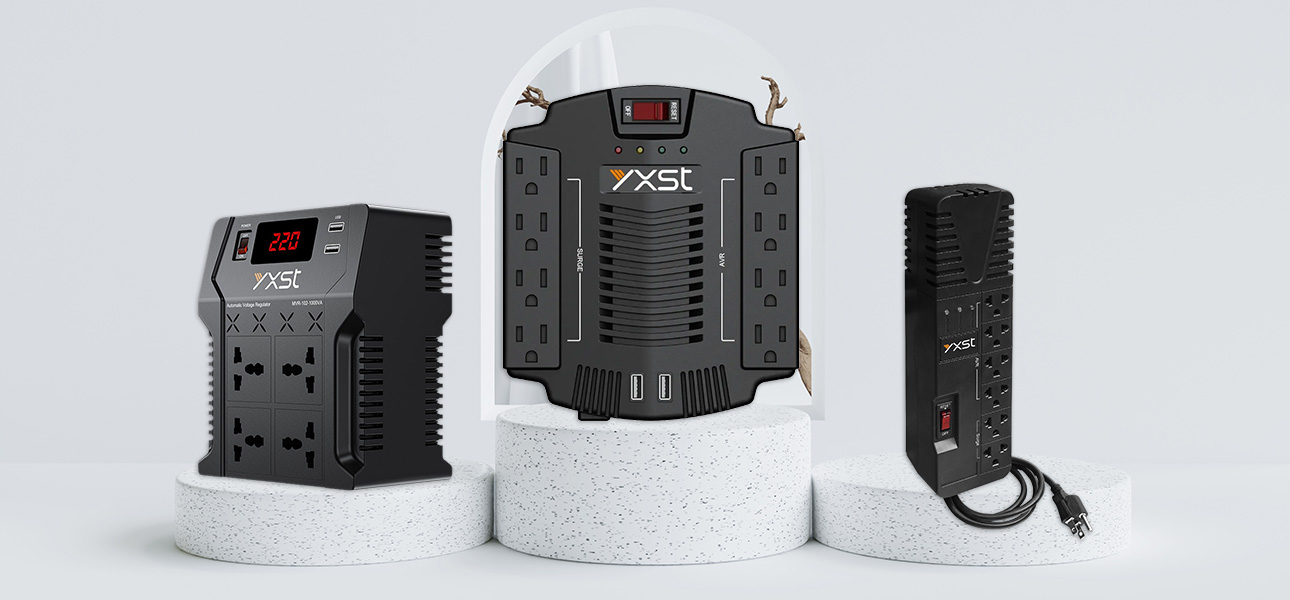
AVR (Automatic Voltage Regulator)
→ Core Function: Stabilize input voltage and adjust unstable mains power to an acceptable range for the equipment (such as 220V±10%) to avoid equipment damage caused by excessively high or low voltage.

→ Protection Range: Focus on voltage fluctuation issues and do not have power outage protection capabilities.
→ Typical Scenarios: Applications of household appliances (such as air conditioners, refrigerators), industrial equipment, etc. in areas with unstable voltage.
Application Selection Recommendations
When choosing UPS:
→ Equipment is sensitive to power outages (e.g., computers without saved data, medical life support systems).
→ The quality of the power grid is poor, and multiple problems such as power outages, voltage fluctuations, and harmonic interference need to be solved at the same time.
→ Examples: Enterprise servers, security monitoring systems, operating room equipment.
When choosing AVR:
→ Voltage is unstable for a long time (e.g., in remote areas or old power grids), but power outages are rare.
→ Equipment has high requirements for voltage accuracy (e.g., precision instruments).
→ Examples: Home air conditioners, refrigerators, laboratory measurement equipment.
Combining the two:
→ In an environment with extremely unstable power grids, AVR can be used as the front stage of UPS to stabilize the voltage first and then provide power outage protection.
→ For example: Large data centers often configure UPS with a voltage stabilization bypass system to improve overall reliability.
Cost and maintenance considerations
Cost:
→ UPS is expensive (including batteries and inverter systems), and the larger the capacity, the more expensive it is.
→ AVR has a simple structure and low cost, but the price of high-precision industrial-grade products may be close to that of low-end UPS.
Maintenance:
→ UPS batteries need to be replaced regularly (lifespan is about 3-5 years), and the inverter status needs to be monitored.
→ AVR mainly maintains servo motors and carbon brushes, and the failure rate is relatively low.
Summary
The core difference between UPS and AVR lies in power failure protection capability and voltage regulation accuracy. UPS is suitable for scenarios with high requirements for power continuity, while AVR focuses more on voltage stability. In an environment with complex power grid quality, the combination of the two can minimize power risks. When choosing, it is necessary to comprehensively evaluate actual power problems, equipment sensitivity and budget constraints.
Error: Contact form not found.
 English
  Español
  Deutsch
  Français
  Italiano
  Português